IASTED Conference Template
Author:
IASTED
Last Updated:
4 months ago
License:
Other (as stated in the work)
Abstract:
\begin
Discover why over 30 million people worldwide trust Overleaf with their work.
\begin
Discover why over 30 million people worldwide trust Overleaf with their work.
\documentclass[twocolumn,letterpaper,10pt]{article}
\usepackage{iasted}
\usepackage{times}
\usepackage[dvips]{graphicx}

\begin{document}

\date{}

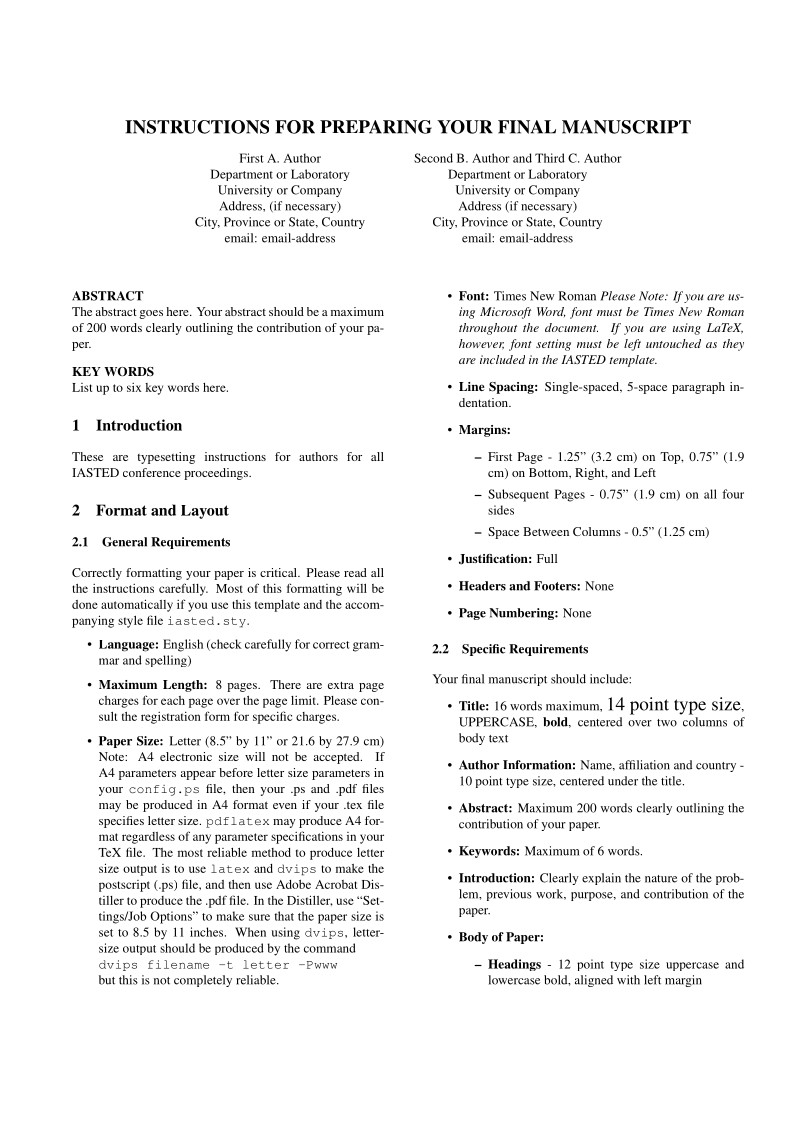
\title{Instructions for Preparing your Final Manuscript}

\author{
First A. Author \\
Department or Laboratory\\
University or Company\\
Address, (if necessary) \\
City, Province or State, Country \\
email: email-address \\
\and
Second B. Author and Third C. Author\\
Department or Laboratory\\
University or Company\\
Address (if necessary)\\
City, Province or State, Country \\
email: email-address \\
}

\maketitle
\thispagestyle{empty}

\noindent
{\bf\normalsize ABSTRACT}\newline
{The abstract goes here. Your abstract should be a maximum of 200 words clearly
outlining the contribution of your paper.} \vspace{2ex}

\noindent
{\bf\normalsize KEY WORDS}\newline
{List up to six key words here.}


\section{Introduction}

These are typesetting instructions for authors for all IASTED conference
proceedings.

\section{Format and Layout}
\subsection{General Requirements}

Correctly formatting your paper is critical. Please read all the instructions
carefully. Most of this formatting will be done automatically if you use this
template and the accompanying style file {\tt iasted.sty}.

\begin{itemize}
    \item {\bf Language:} English (check carefully for correct grammar and
    spelling)
    \item {\bf Maximum Length:} 8 pages. There are extra page charges for
    each page over the page limit.  Please consult the registration form
    for specific charges.
    \item {\bf Paper Size:} Letter (8.5" by 11" or 21.6 by 27.9 cm) Note:
    A4 electronic size will not be accepted. If A4 parameters appear before
    letter size parameters in your {\tt config.ps} file, then your .ps and .pdf
    files may be produced in A4 format even if your .tex file specifies
    letter size. {\tt pdflatex} may produce A4 format regardless of any
    parameter specifications in your TeX file. The most reliable method
    to produce letter size output is to use {\tt latex} and {\tt dvips}
    to make the postscript (.ps) file, and then use Adobe Acrobat Distiller
    to produce the .pdf file.  In the Distiller, use ``Settings/Job Options'' to make sure that the paper
    size is set to 8.5 by 11 inches. When using {\tt dvips}, letter-size output
    should be produced by the command
    \newline {\tt dvips filename -t letter -Pwww}\newline
    but this is not completely reliable.
    \item {\bf Font:} Times New Roman  {\em Please Note: If you are using Microsoft Word, font must be Times New Roman throughout the document. If you are using LaTeX, however, font setting must be left untouched as they are included in the  IASTED template.}
    \item {\bf Line Spacing:} Single-spaced, 5-space paragraph indentation.
    \item {\bf Margins:}
    \begin{itemize}
        \item First Page - 1.25" (3.2 cm) on Top, 0.75" (1.9 cm) on
                           Bottom, Right, and Left
        \item Subsequent Pages - 0.75" (1.9 cm) on all four sides
        \item Space Between Columns - 0.5" (1.25 cm)
    \end{itemize}
    \item {\bf Justification:} Full
    \item {\bf Headers and Footers:} None
    \item {\bf Page Numbering:} None
\end{itemize}

\subsection{Specific Requirements} Your final manuscript should include: \begin{itemize}
\item {\bf Title:} 16 words maximum, {\Large 14 point type size}, UPPERCASE, {\bf bold},
centered over two columns of body text
\item {\bf Author Information:} Name, affiliation and country - 10 point type
size, centered under the title.
%%\item {\bf Paper:}
%%    \begin{itemize}
%%    \item Headings - 12 point type size uppercase and lowercase bold,
%%    aligned with left margin
%%        \item Text Size - 10 point type size, upper and lower case
%%    \item Columns - 2 columns, 0.50" space between columns
%%    \end{itemize}
\item {\bf Abstract:} Maximum 200 words clearly outlining the contribution of your paper.
\item {\bf Keywords:} Maximum of 6 words.
\item {\bf Introduction:} Clearly explain the nature of
the problem, previous work, purpose, and contribution of the paper.
\item {\bf Body of Paper:}
    \begin{itemize}
    \item {\bf Headings} - 12 point type size uppercase and lowercase bold,
    aligned with left margin
    \item {\bf Subheadings} - 10 point type size uppercase and lowercase bold,
    aligned with left margin
\item {\bf Indentation} - The first paragraph of every section should not be indented, but
every subsequent paragraph should
    \item {\bf Text Size} - 10 point type size, upper and lower case
    \item {\bf Columns} - 2 columns, 0.50" space between columns
    \item {\bf Tables and Graphs} - type size 8 point minimum, line
    thickness minimum .013" or .30 mm, captions - upper and lower case,
    centered over 1 or 2 columns of body text
    \item {\bf Illustrations and Photographs} - halftones, type
    size 8 point minimum, captions - upper and lower case, centered over
    1 or 2 columns of body text
    \item {\bf Diagrams and Images} must be computer-designed and
    submitted as embedded images in your document (postscript or MS Word
    format).  Digitized  photographs in 256 greyscale are recommended.
    Colour images are acceptable but the author must ensure they appear clearly when printed in black and white.
    \item {\it Note:} - {\it All images, photographs, and illustrations have to be in PRINT resolution (high resolution 300dpi) in order for them to print}
    \end{itemize}
\item {\bf Conclusion:} Should clearly indicate advantages, limitations and
possible applications

\item {\bf  Acknowledgements:}
A brief acknowledgement section may be included between the Conclusion and
References (optional).  Do not include author biographies.

\item {\bf References:} Must be numbered in the order cited in the manuscript
and indicated in the text by a number in square brackets ({\it e.g.}, [1]).\newline
\newline
The required format for references is:
    \begin{itemize}
    \item {\bf Papers:}
    Author, paper title, {\em journal name (in italics)}, volume and issue
    numbers, year, inclusive pages. {\it e.g.}: \smallskip \newline
    [1] T.C. Hsia, Simple robust schemes for space control
    of robot manipulators, {\it Int. J. of Robotics and Automation}, 9(4),
    1994, 167-174.
    \item {\bf Books:} Author, {\em title (in italics)} (location of
    publisher, publisher, year). {\it e.g.}:\smallskip \newline
    [2] M. Kayston and W.R. Fried, {\it Avionic Navigation
    Systems} (New York: John Wiley and Sons Inc., 1969).
    \item {\bf Chapters in Books:} Chapter Author, Chapter Title, in
    Editor (Ed.), {\em title (in italics)}  (location of publisher,
    publisher, year) inclusive pages. {\it e.g.}: \smallskip \newline
    [3] P.O. Biship, Neurophysiology of binocular vision,
    in J. Housman (Ed.) {\em Handbook of physiology}, 4 (New York:
    Springer-Verlag, 1970) 342-366.
    \item {\bf Proceedings Papers:} Author, paper title, {\em proceedings
    title (in italics)}, City, Country, year, inclusive pages. {\it e.g.}:
    \smallskip \newline
    [4] W.J. Book, Modelling design and control of
    flexible manipulator arms: A tutorial review, {\it Proc. 29th IEEE Conf. on
    Decision and Control}, San Francisco, USA, 1990, 500-506.
    \end{itemize}
\end{itemize}

\section{Submitting your Final Manuscript} PLEASE SEE CONFERENCE HOME PAGE FOR SUBMISSION DEADLINE \newline
\newline
In order for your final manuscript to
be published, the following conditions must be satisfied:
\begin{enumerate}
\item Your paper must be registered and fully paid-for by the
registration deadline.
\item Your paper must be presented at the conference by one of the authors.
\item Your paper must be submitted online via our website as an
Adobe Acrobat(.pdf) attachment by the final manuscript
submission deadline.
\end{enumerate}
Papers poorly produced or incorrectly formatted will not be
included in the proceedings.
%%%%%%%%%%%%%%%%%%%%%%%%%%%%%%%%%%%%%%%%%%%%%%%%%%%%%%%%%%%%%%%%%%%%%%%%%%%%%%%%%%%%%%%%%%%%%%%%%%%%
\end{document}